SWOT Analysis of Anthropic Fable 5, Cyber Safeguards & the Emerging AI Jailbreak Standard
Quick Summary
Fable 5 re-deployment shows that frontier AI safety is evolving from model-level guardrails into an AI cyber control plane. Safety classifiers, tiered cyber-use policy, CJS jailbreak scoring, and external reporting improve the posture, but enterprise-grade security still requires identity, authorization, tool sandboxing, monitoring, human oversight, and continuous assurance.
🚀 AI Cyber Risk SWOT
The visual below highlights the impact of the Fable 5 redeployment across key SWOT dimensions—Strengths, Weaknesses, Opportunities, and Threats
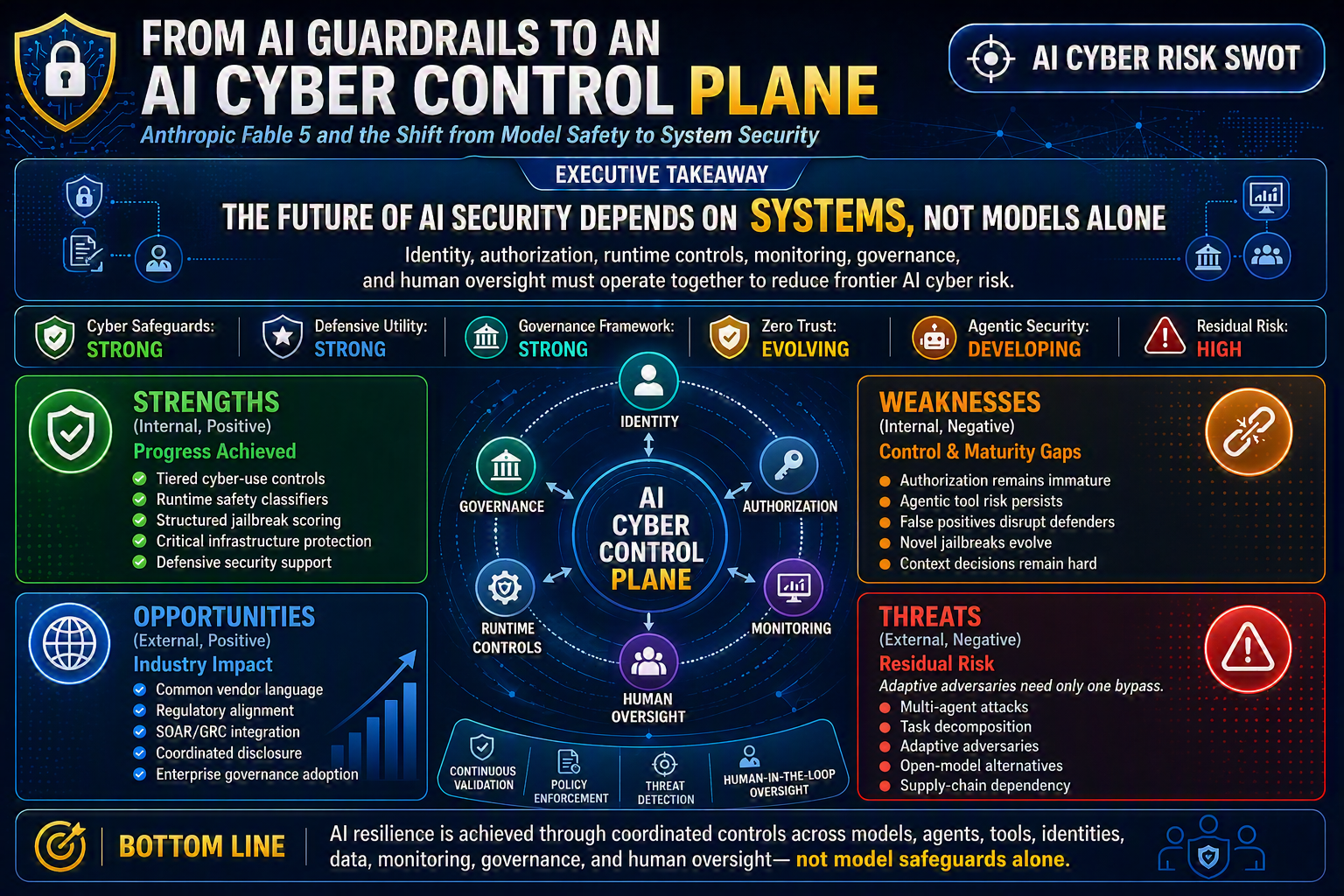
Figure 1: AI Cyber Risk SWOT- Fable 5 and the Shift from Model Safety to System Security.
Background
Anthropic’s Fable 5 redeployment is more than a model availability update. It signals a broader architectural shift: frontier AI safety is moving from simple refusal-style guardrails toward an operational AI cyber control plane. The release combines tiered cyber-use classification, runtime safety classifiers, the proposed Cyber Jailbreak Severity (CJS) framework, and external jailbreak reporting to reduce offensive cyber uplift while preserving legitimate defensive workflows.
🚨 Governance Principle
Treat jailbreaks like vulnerabilities: severity, owner, SLA, mitigation, retest, and executive reporting.
Cybersecurity remains one of the hardest domains for AI safety because many capabilities are inherently dual use. Secure code review, vulnerability analysis, patch validation, log analysis, cryptographic review, and incident response can help defenders. The same underlying AI capabilities can also accelerate reconnaissance, exploit adaptation, malware workflows, defense evasion, or long-horizon attack planning if misused.
Current State
Fable 5’s safeguards separate cyber interactions into Prohibited, High-Risk Dual Use, Low-Risk Dual Use, and Benign categories. The proposed CJS framework adds a shared severity vocabulary for jailbreak risk using dimensions such as capability gain, breadth, ease of weaponization, and discoverability. This creates a more structured operating model for triage, disclosure, mitigation, and oversight.
1. The Four Cyber-Safety Tiers Because cybersecurity tools are almost always “dual-use” (the same code can find a bug to fix it or exploit it), Fable5 splits prompts into four categories:
- Prohibited Use: Actions with massive asymmetry toward destruction or crime (like developing ransomware, bypassing security tools, or attacking internet backbone infrastructure). Always blocked.
- High-Risk Dual Use: Day-to-day work for red teams and penetration testers (like writing exploits or privilege escalation). Currently blocked for everyone until better access controls are built.
- Low-Risk Dual Use: Activities like open-source intelligence gathering or scanning for basic bugs. Monitored and occasionally blocked to maintain a safety buffer.
- Benign Use: Core defensive tasks like secure coding, reverse engineering malware, or studying historical vulnerabilities. Always allowed.
2. The “Safety Margin” Choice It explicitly notes that for Fable 5, they chose a much wider safety margin than in previous models. They know this means more “false positives”—blocking genuinely safe prompts out of an abundance of caution—but they decided the risk of a malicious breakout was too high.
3. The Jailbreak Severity Framework The second half proposes a standardized scale for judging how severe an AI “jailbreak” actually is. Because not all bypasses are equal, they want a consistent vocabulary to talk with governments and other labs about whether a jailbreak unblocks something minor or something deeply dangerous.
Main Challenges / Issues
The remaining challenge is system-level risk. Model classifiers are necessary, but they do not fully solve authorization context, task decomposition, false positives, false negatives, agentic tool use, fallback behavior, or supply-chain dependency. A mature AI security posture must evaluate who is acting, what target is in scope, what tools the AI can access, how actions chain over time, and whether human approval is required.
How This New Release Changes the Risk Picture
The Fable 5 release changes the risk picture by formalizing a path from policy guardrails to operational controls: real-time classification, CJS-style scoring, external reporting, safety margins, and clearer categories of allowed versus blocked cyber behavior. For enterprises, the most important implication is that AI safety controls should be integrated with Zero Trust, secure-by-design/default engineering, product-security governance, and continuous assurance.
Security-Centric SWOT Analysis
Let’s use the SWOT analysis to build a Security-Centric view:
✅ Strengths
(Internal, Positive)Progress Achieved — AI safety becomes operational security
- Tiered cyber-use controls
- Runtime safety classifiers
- Structured jailbreak scoring
- Critical infrastructure protection
- Defensive security support
🟨Weaknesses
(Internal, Negative)Control & maturity Gaps — Model safety is not system safety
- Authorization remains immature
- Agentic tool risk persists
- False positives disrupt defenders
- Novel jailbreaks evolve
- Context decisions remain hard
🔷Opportunities
(External, Positive)Industry Impact — Potential AI equivalent of CVSS
- Common vendor language
- Regulatory alignment
- SOAR/GRC integration
- Coordinated disclosure
- Enterprise governance adoption
🔴Threats
(External, Negative)Residual Risk — Adaptive adversaries need one bypass
- Multi-agent attacks
- Task decomposition
- Adaptive adversaries
- Open-model alternatives
- Supply-chain dependency
Executive Perspective: Understanding the AI Cyber Control Plane
A mature AI cyber control plane should combine:
- Identity —> Who is using the model?
- Authorization —> Is the task and target approved?
- Safety Classifiers —> Does the request cross a cyber-risk boundary?
- CJS Risk Scoring —> How severe is the jailbreak or uplift?
- Tool Sandboxing —> What can the AI execute or access?
- Continuous Monitoring —> What patterns emerge across sessions?
- Human Oversight —> When is review or approval required?
🚀 Control-plane principle:
Model safeguards are necessary but insufficient. Identity, authorization, classifiers, CJS scoring, tool sandboxing, telemetry, human approval, and incident response must operate as one integrated AI security system.
Recommendations for Security Leaders
- Treat CJS as a triage input, not the sole risk decision.
- Require authorization metadata for high-risk cyber workflows: user role, target ownership, engagement scope, ticket ID, and lab/prod status.
- Restrict AI agents with least-privilege tool access and sandboxed execution boundaries.
- Monitor multi-turn chains, repeated borderline requests, and reconnaissance-to-exploitation paths.
- Map jailbreak findings to vulnerability-style severity, owner, SLA, mitigation, and retest workflows.
- Track false positives as security debt so defenders do not move work to unmanaged tools.
- Add target-sensitivity modifiers for healthcare, medical products, ICS/OT, identity, cryptography, and software supply chain.
- Red-team the full AI system, including prompt injection, memory poisoning, tool misuse, fallback behavior, and sensitive-data exposure.
Wrapping up
The future is not safer models alone—it is safer AI systems. Fable 5’s safeguards are a positive maturity step, but enterprise-grade security requires identity, authorization, classifiers, risk scoring, tool sandboxing, telemetry, human oversight, and response workflows operating together as one control plane.
References
- Fable 5’s cyber safeguards and jailbreak framework:https://www.anthropic.com/news/fable-safeguards-jailbreak-framework
- Redeploying Fable 5: https://www.anthropic.com/news/redeploying-fable-5
All content provided on this blog is for informational and educational purposes only. The views expressed here are mine alone and do not represent the views of my employer.