Healthcare Manufacturing Product Security Leadership Playbook (2026+)
Product Security in Healthcare manufacturing space is no longer limited to connected devices or late-stage vulnerability remediation. A Product Security Leader may inherit a global portfolio of disconnected legacy products, connected hospital-deployed systems, last-generation platforms, cloud and mobile companion applications, SaMD, AI-enabled functions, regulated and non-regulated products, and new product development programs.
Core leadership premise
Product security in healthcare manufacturing is a lifecycle operating model that connects product design, quality, regulatory strategy, vulnerability management, post-market surveillance, customer trust, and Innovation initiatives like AI adoption, and post-quantum readiness.
🚀 Product Security Foundational Drivers
Regulatory: FDA 524B • EU MDR • EU Cyber Resilience Act
Safety & Quality: ISO 14971 • IEC 62304 • IEC 81001-5-1
Product Security: AAMI TIR57 • Secure-by-design • NIST SSDF • SBOM • PSIRT
Future Readiness: AI Governance • PQC Readiness • Crypto Agility
Secure-by-Design • Quality-by-Design • Lifecycle Security
Executive Summary
A Product Security Leader should use the first 90 days to establish visibility, governance, risk prioritization, quality integration, and investment alignment across the product portfolio. The leader’s job is not to chase every issue equally. The job is to create a sustainable operating model that embeds security into product quality, design controls, risk management, post-market surveillance, and regulatory processes.
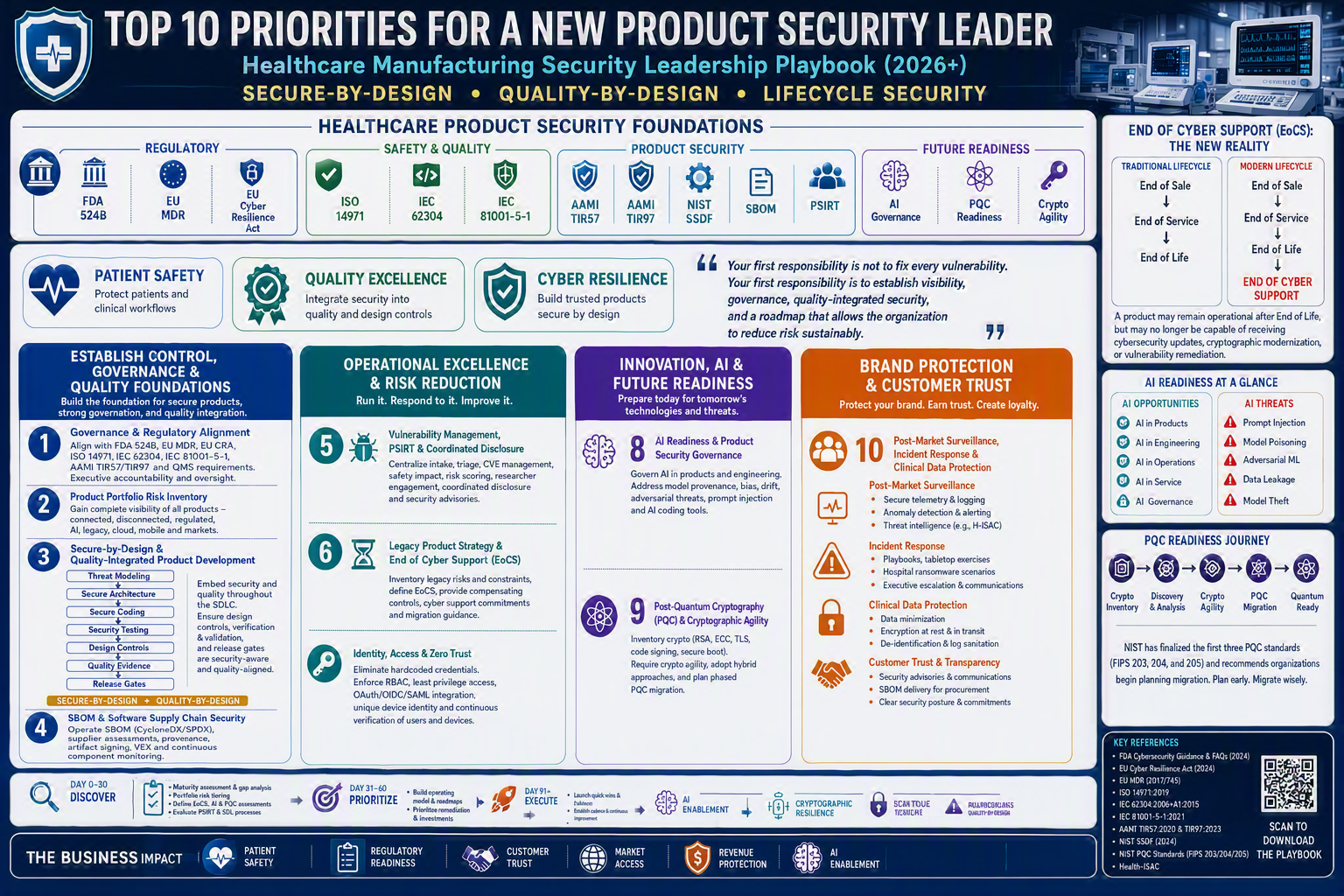
Executive leadership principle- by an ex-google CISO
“Your first responsibility is not to fix every vulnerability. Your first responsibility is to establish visibility, governance, quality-integrated security, and a roadmap that allows the organization to reduce risk sustainably.”
Why Product Security Must Be Integrated With Quality
In healthcare manufacturing, product security should not operate as a standalone cybersecurity function. The strongest programs embed product security directly into Design Controls, Risk Management, Quality Systems, Product Development, Post-Market Surveillance, and Regulatory Compliance.
Secure-by-Design + Quality-by-Design Integration Model
Product Security should be fully integrated with:
Design Controls → Risk Management → Quality Systems → Product Development → Post-Market Surveillance → Regulatory Compliance
Charting the Course: The Top 10 Priorities
The product security leadership framework of Top 10 priorities -organized into four executive focus areas:
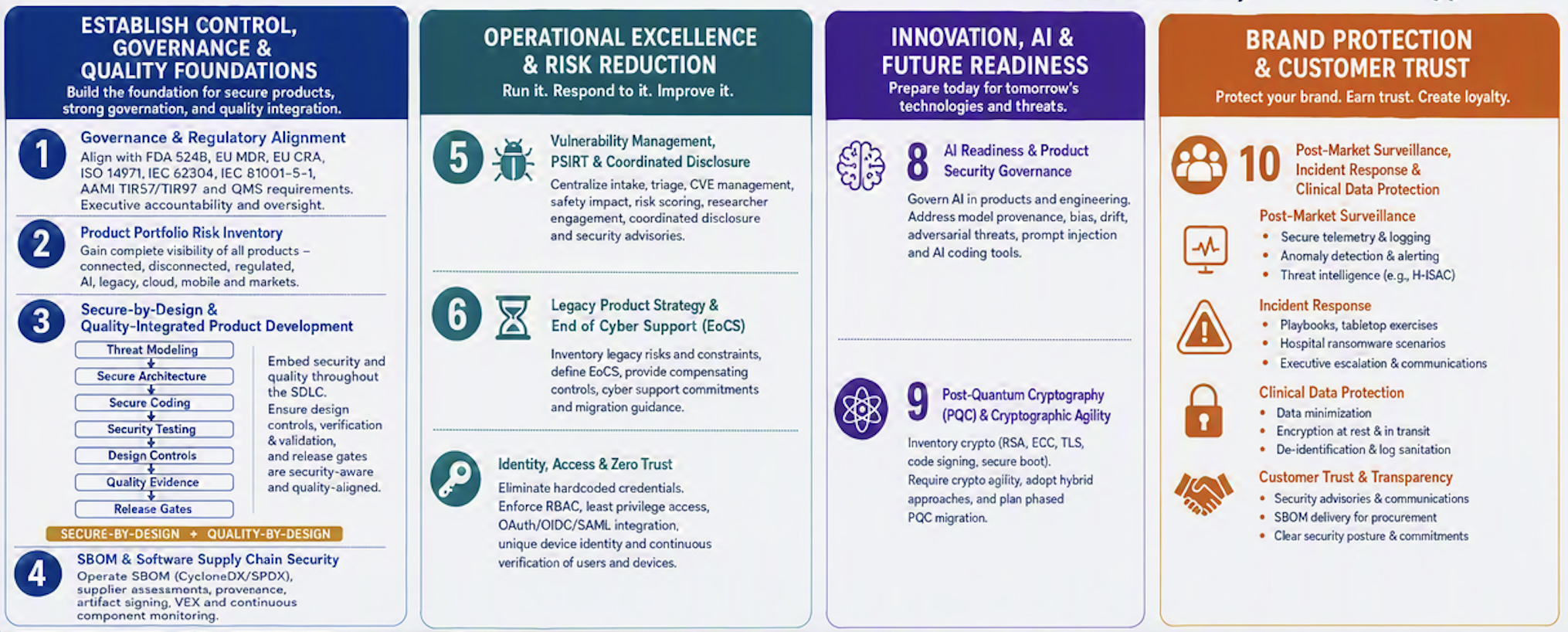
🚨 Executive Focus Areas- Top 10 Priorities
A. Establish Control, Governance & Quality Foundations — build the foundation for secure products, strong governance, and quality integration.
- Establish Product Security Governance and Regulatory Alignment
- Create a Product Portfolio Risk Inventory
- Build Secure-by-Design and Quality-Integrated Product Development Framework
- Implement SBOM and Software Supply Chain Security Controls
B. Operational Excellence & Risk Reduction — run it, respond to it, and improve it.
-
Modernize Vulnerability Management, PSIRT, and Coordinated Vulnerability Disclosure
-
Define Legacy Product Security Strategy and End of Cyber Support for risk management
-
Strengthen Identity, Access, and Zero Trust for Products
C. Innovation, AI & Future Readiness — prepare today for tomorrow’s technologies and threats.
-
Build AI Readiness and AI Product Security Governance
-
Launch a Post-Quantum Readiness program (e.g. Cryptography)
D. Brand Protection & Customer Trust — protect your brand, stayed compliant, earn trust, and create loyalty.
- Strengthen Post-Market Monitoring, Incident Response, and Clinical Data Protection (especially in AI adoption)
A. Establish Control, Governance & Quality Foundations
Build the foundation for secure products, strong governance, and quality integration. You cannot secure what you cannot govern, see, measure, or fund.
1. Establish Product Security Governance and Regulatory Alignment
A new Product Security Leader should establish decision rights, accountability, and regulatory alignment across engineering, quality, regulatory, cloud operations, enterprise security, privacy, legal, suppliers, and product management.
Priority 1: Governance & Regulatory Alignment
- Create a Product Security Steering Committee.
- Establish a Product Cyber Risk Review Board.
- Map controls to FDA 524B, EU MDR, EU CRA, IEC 81001-5-1, AAMI TIR57/TIR97, ISO 14971, IEC 62304, and internal QMS requirements.
- Define risk acceptance, security exception, funding, escalation, and customer/regulatory communication workflows.
Leadership outcome: A single product cyber risk decision system that connects engineering, quality, regulatory, legal, commercial, and executive leadership.
2. Create a Product Portfolio Risk Inventory
The first operational deliverable should be a product security inventory covering connected, disconnected, regulated, non-regulated, legacy, last-generation, AI-enabled, cloud-connected, mobile-enabled, and NPD products.
Priority 2: Product Portfolio Risk Inventory
- Build one authoritative inventory for connected, disconnected, regulated, non-regulated, legacy, and NPD products.
- Track SBOM availability, operating systems, software/firmware versions, cryptographic dependencies, AI usage, update capability, install base, support commitments, and known vulnerabilities.
- Risk-tier products by exploitability, patient safety impact, data sensitivity, connectivity, revenue impact, and patchability.
Leadership outcome: A single source of truth for portfolio cyber risk and investment prioritization.
3. Build Secure-by-Design and Quality-Integrated Product Development
Secure-by-design and quality-integrated development must be embedded into NPD and product maintenance—not bolted on at release.
Priority 3: Secure-by-Design & Quality-Integrated Product Development
- Embed threat modeling before code is written.
- Integrate security requirements, secure architecture, secure coding, SAST, DAST, SCA, secrets scanning, fuzzing, penetration testing, SBOM generation, privacy review, and cryptographic design review.
- Establish security sign-off gates before manufacturing transfer or commercial release.
- Integrate security evidence with design controls, quality processes, verification/validation, and regulatory documentation.
Leadership outcome: Security becomes part of product quality—not a separate activity—and is integrated into design controls, risk management, verification/validation, and release readiness.
4. Implement SBOM and Software Supply Chain Security
SBOM generation alone is not enough. Healthcare manufacturers need SBOM operations: generation, storage, monitoring, supplier intake, vulnerability correlation, VEX support, and customer delivery.
Priority 4: SBOM & Software Supply Chain Security
- Generate machine-readable SBOMs using CycloneDX or SPDX.
- Store and version SBOMs by product release.
- Continuously monitor SBOM components for newly disclosed vulnerabilities.
- Establish supplier SBOM requirements, security SLAs, audit rights, patch obligations, artifact signing, build integrity, and software provenance controls.
Leadership outcome: The organization can quickly answer, “Are we affected, where, and what will we do?” when a new component vulnerability is disclosed.
B. Operational Excellence & Risk Reduction
Run it. Respond to it. Improve it. Knowing the risks is not enough; healthcare manufacturers must operationalize mitigation, communication, and response.
5. Modernize Vulnerability Management, PSIRT, and Coordinated Vulnerability Disclosure
Product vulnerability management may require safety impact analysis, regulatory assessment, change control, verification and validation, customer communication, and field remediation planning.
Priority 5: Vulnerability Management, PSIRT & CVD
- Create a public reporting portal for researchers and customers.
- Establish PSIRT triage SLAs and severity models.
- Link CVEs to SBOMs, affected products, install base, exploitability, and clinical impact.
- Publish advisories and patches with clear customer guidance.
Leadership outcome: Faster, more predictable vulnerability response with fewer surprises for customers, regulators, and executives.
6. Define Legacy Product Strategy and End of Cyber Support
Traditional End of Life language is insufficient for product security. A product may remain operational while no longer being capable of receiving modern cybersecurity updates.
Definition: End of Cyber Support
End of Cyber Support is the point at which the manufacturer can no longer reasonably provide vulnerability remediation, cryptographic modernization, cybersecurity updates, coordinated vulnerability response, or security assurance for a product, even if that product remains physically operational or present in customer environments.
Priority 6: Legacy Product Strategy & End of Cyber Support
- Inventory 10+ year products and unsupported components.
- Identify weak crypto, hardcoded credentials, unsupported OS, and limited patchability.
- Define compensating controls such as segmentation, allowlisting, restricted service access, and monitoring.
- Publish cyber support commitments, sunset criteria, migration paths, and customer communication plans.
Leadership outcome: Legacy cyber risk becomes explicit, governed, and transparent instead of hidden in vague EOL assumptions.
7. Strengthen Identity, Access, and Zero Trust for Products
Hardcoded credentials, shared service accounts, unmanaged maintenance interfaces, and weak authentication can expose products to ransomware, unauthorized access, and hospital network risk.
Priority 7: Identity, Access & Zero Trust for Products
- Audit products for hardcoded credentials and default passwords.
- Implement unique device identity, certificate-based authentication, RBAC, least privilege, and service access governance.
- Support OAuth, OIDC, SAML, or hospital IAM integration where feasible.
Leadership outcome: Reduced unauthorized access risk across devices, service channels, cloud integrations, and hospital environments.
C. Innovation, AI & Future Readiness
Prepare today for tomorrow’s technologies and threats. Products designed today must withstand tomorrow’s regulatory, AI, and cryptographic realities.
8. Build AI Readiness and AI Product Security Governance
AI adoption in healthcare manufacturing spans regulated medical functionality, engineering workflows, service operations, vulnerability triage, product telemetry, and customer-facing experiences.
Priority 8: AI Readiness & AI Product Security Governance
- Inventory AI use across products, engineering, service, and operations.
- Govern model provenance, training data, validation, explainability, bias, drift, monitoring, and change control.
- Address prompt injection, model poisoning, adversarial manipulation, model theft, unsafe automation, and AI-generated code risk.
Leadership outcome: AI innovation scales safely, securely, and with regulatory readiness.
9. Launch a Post-Quantum Cryptography Readiness Program
Healthcare products may remain deployed for 10, 15, or 20 years. Products designed today may still be operating when quantum-vulnerable cryptography becomes unacceptable.
Priority 9: PQC & Cryptographic Agility
- Inventory RSA, ECC, ECDH, ECDSA, DH, TLS, certificates, secure boot, firmware updates, and code signing dependencies.
- Add crypto-agility requirements to NPD.
- Assess hardware, firmware, secure elements, memory, compute, bandwidth, suppliers, and hybrid PQC readiness.
Leadership outcome: Products become crypto-agile before quantum-driven migration becomes urgent and expensive.
D. Brand Protection & Customer Trust
Protect your brand. Earn trust. Create loyalty. Trust is one of the most valuable products a healthcare manufacturer delivers.
10. Strengthen Post-Market Surveillance, Incident Response, and Clinical Data Protection
Customers expect manufacturers to know their products, monitor relevant threats, communicate clearly, protect clinical data, and respond quickly when vulnerabilities or incidents occur.
Priority 10: Brand Protection & Customer Trust
- Build privacy-aware post-market surveillance and telemetry capabilities.
- Participate in healthcare sector threat intelligence communities such as Health-ISAC.
- Practice product incident tabletop exercises with quality, regulatory, legal, communications, service, and engineering.
- Protect PHI through minimization, encryption, anonymization, diagnostic control, and transparent customer advisories.
Leadership outcome: Stronger customer confidence, improved crisis readiness, better brand protection, and more resilient market trust.
90-Day Execution Plan
Days 0–30: Discover, Stabilize, and Establish Governance
- Meet leaders across Product, Engineering, Quality, Regulatory, Legal, Privacy, Enterprise Security, Cloud, Manufacturing, Service, and Commercial.
- Establish Product Security Steering Committee.
- Create initial product security inventory and top risk watchlist.
- Review vulnerability backlog, PSIRT maturity, NPD security gates, and quality-system integration.
- Launch initial AI and cryptographic dependency discovery.
Days 31–60: Assess Maturity, Prioritize Risk, and Define the Operating Model
- Conduct maturity assessment across the 10 priority domains.
- Segment product portfolio by cyber risk tier.
- Draft End of Cyber Support criteria.
- Establish Secure-by-Design and Quality-by-Design minimum baseline for NPD.
- Define SBOM operations, AI readiness, PQC readiness, and product security metrics.
Days 61–90: Execute Quick Wins and Present the Investment Roadmap
- Close, remediate, or disposition highest-risk vulnerability backlog items.
- Pilot threat modeling on one NPD program.
- Pilot SBOM monitoring on one connected product family.
- Finalize End of Cyber Support policy and launch crypto-agility requirements.
- Present investment roadmap, funding needs, and quarterly governance cadence.
Wrapping Up
The first 90 days should focus on establishing control, operationalizing security, preparing for future threats, and protecting customer trust. The strongest Product Security Leaders will connect cybersecurity investments to patient safety, quality excellence, regulatory readiness, customer trust, market access, revenue protection, AI enablement, and cryptographic resilience.
Final takeaway
In healthcare manufacturing, product security is becoming a strategic business capability: secure products, improve quality, earn trust, and enable innovation.
References
- FDA Cybersecurity for Medical Devices: https://www.fda.gov/medical-devices/digital-health-center-excellence/cybersecurity
- FDA Cybersecurity in Medical Devices FAQs: https://www.fda.gov/medical-devices/digital-health-center-excellence/cybersecurity-medical-devices-frequently-asked-questions-faqs
- EU Cyber Resilience Act Regulation (EU) 2024/2847: https://eur-lex.europa.eu/eli/reg/2024/2847/oj/eng
- IEC 81001-5-1: https://www.iso.org/standard/76097.html
- AAMI TIR57: https://webstore.ansi.org/standards/aami/aamitir572016r2023
- FDA AI-Enabled Device Software Functions Draft Guidance: https://www.fda.gov/regulatory-information/search-fda-guidance-documents/artificial-intelligence-enabled-device-software-functions-lifecycle-management-and-marketing
- NIST Post-Quantum Cryptography Standards Announcement: https://csrc.nist.gov/News/2024/postquantum-cryptography-fips-approved
- Health-ISAC: https://health-isac.org/
All content provided on this blog is for informational and educational purposes only. The views expressed here are mine alone and do not represent the views of my employer.