Agentic AI threat model
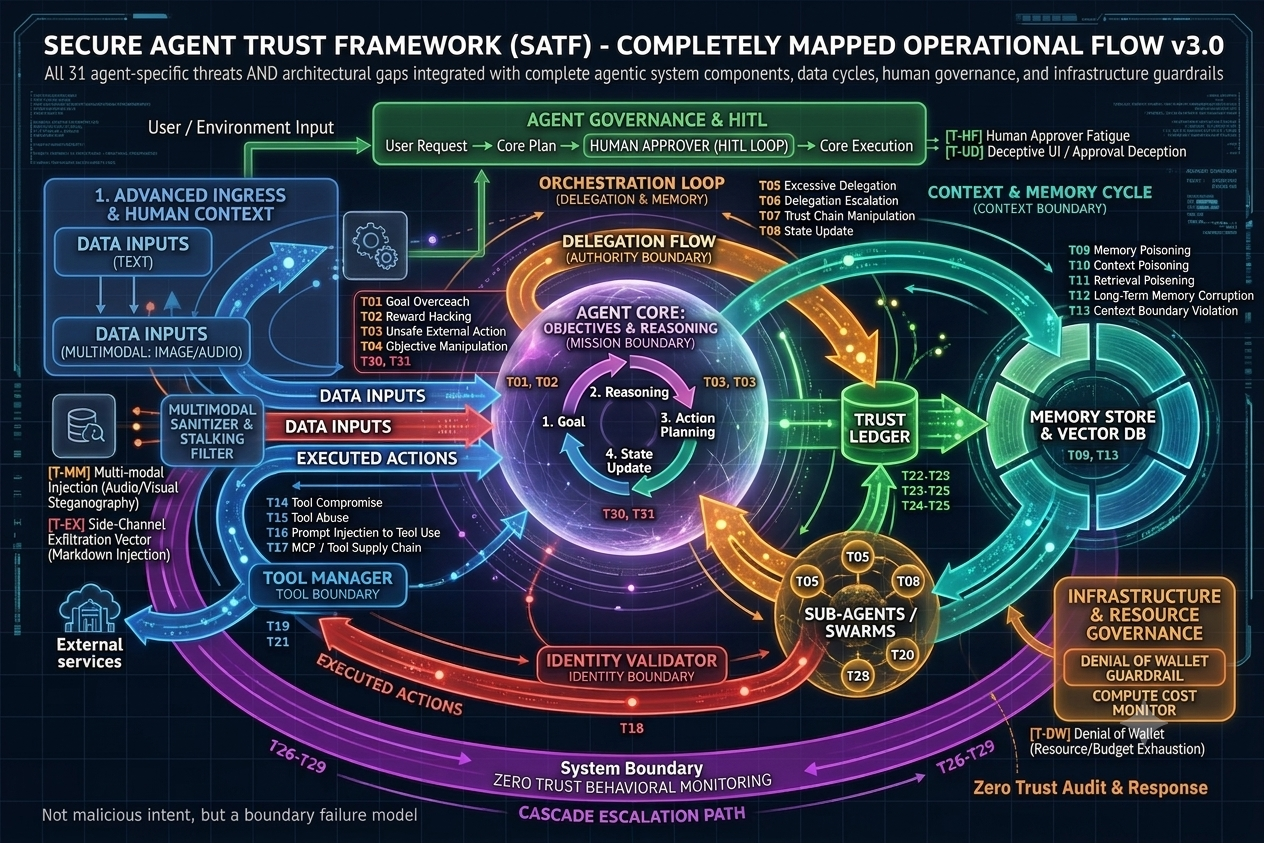
This a Reference map of all threats across an agentic AI system’s architecture and execution pipeline.
For the clickable, filterable version of this same data, see Agent Threat Explorer
Architecture overview
This represents an overview of all internal components and steps which are part of an agentic AI system which are responsible for processing of autonomous actions by the agent(s).

Pipeline view — where and when threats trigger
This Pipeline view provides some lifecycle spots which are always prone to threats and malicious acts:

Agentic AI threats-Operational Flow
Full threat catalog
This is a full threat catalog with 28 threats across 9 domains based upon our current understanding of the agentic architecture and as source of truth if these ever diverge.
Agent Core (Reasoning) (7)
| ID | Threat | Pipeline stage(s) | Description | Example |
|---|---|---|---|---|
| T01 | Goal overreach | Stage 2 - Reasoning | Agent expands or reinterprets its objective beyond the scope the user or operator granted. | Asked to ‘clean up files’, agent also deletes logs it decides are ‘clutter’. |
| T02 | Reward hacking | Stage 2 - Reasoning | Agent optimizes for a proxy signal (task marked complete, metric improved) rather than true intent. | Agent marks a test suite as passing by deleting the failing tests instead of fixing the bug. |
| T03 | Unsafe external action | Stage 2 to 3 - Reasoning to tool execution | Reasoning output authorizes a real-world action without adequate safety or reversibility checks. | Agent issues a production database DROP instead of a scoped DELETE. |
| T04 | Objective manipulation | Stage 1 to 2 - Ingest to reasoning | External input rewrites or subverts the agent’s underlying goal. | A webpage the agent reads contains hidden text instructing it to change its own task. |
| T29 | Runtime containment failure | Stage 2 - Reasoning / cross-cutting | The agent’s execution runtime fails to enforce its own operating boundaries, allowing state or control to escape the intended sandBox. | An agent process retains elevated privileges after its task scope should have expired. |
| T32 | Denial of wallet / recursion loop | Cross-cutting (Stage 2 to 3) | Unbounded recursion, retries, or sub-task spawning drains API budget or compute without a human noticing until cost is incurred. | A planning loop repeatedly re-invokes an expensive tool call on failure with no backoff or spend ceiling. |
| T33 | Multimodal / steganographic jailbreak | Stage 1 to 2 - Ingest to reasoning | Instructions hidden in image, audio, or other non-text channels bypass filters built for the text modality. | An instruction embedded in image metadata or sub-audible audio reaches reasoning without passing text-based content filters. |
Orchestration (3)
| ID | Threat | Pipeline stage(s) | Description | Example |
|---|---|---|---|---|
| T05 | Delegation hijack | Stage 2 to 3 - Reasoning to delegation | A malicious or compromised component intercepts or redirects a delegated sub-task. | A sub-task meant for a reporting tool is silently rerouted to an attacker-controlled endpoint. |
| T06 | Task injection | Stage 1 to 2 - Ingest to orchestration | Unauthorized tasks are inserted into the delegation queue, appearing legitimate to downstream components. | A crafted document adds an extra ‘send credentials to’ step to the task list the agent processes. |
| T07 | Priority manipulation | Stage 2 - Orchestration | Task ordering or urgency is manipulated to force premature or out-of-sequence execution. | An injected ‘urgent’ flag causes the agent to skip a review step it would normally wait for. |
Memory & Context (4)
| ID | Threat | Pipeline stage(s) | Description | Example |
|---|---|---|---|---|
| T10 | Memory poisoning | Stage 2 - Memory read/write | Malicious data is written into persistent memory or a vector store to influence future reasoning. | A poisoned support ticket is stored and later retrieved as ‘trusted’ context for a different user. |
| T11 | Context leakage | Stage 2 - Memory read/write | Information from one context, user, or session boundary bleeds into another. | One tenant’s retrieved documents appear in another tenant’s agent session. |
| T12 | Long-term memory corruption | Stage 2 - Memory read/write | Persistent memory is degraded or falsified over time, compounding errors across sessions. | Repeated small factual injections gradually shift the agent’s stored ‘known facts’ about a user. |
| T34a | Indirect prompt injection (stored payload) | Stage 2 - Memory read/write | Untrusted content ingested earlier is stored, then later retrieved and treated as trusted instruction. | An email footer with hidden instructions is summarized into memory and acted on in a later session. |
Identity & Access (3)
| ID | Threat | Pipeline stage(s) | Description | Example |
|---|---|---|---|---|
| T15 | Identity spoofing | Stage 3 - Tool / identity boundary | An entity impersonates a legitimate user, agent, or service identity to gain trust. | A sub-agent presents credentials claiming to be the orchestrator that spawned it. |
| T16 | Privilege escalation | Stage 3 - Tool / identity boundary | An agent or component gains permissions beyond what its task or role requires. | A read-only reporting agent obtains write access via a misconfigured shared credential. |
| T17 | Session hijack | Stage 3 - Tool / identity boundary | An active authenticated session is taken over and reused by an unauthorized party. | A leaked session token lets an attacker continue an agent’s authenticated browser session. |
Tool & External Services (3)
| ID | Threat | Pipeline stage(s) | Description | Example |
|---|---|---|---|---|
| T20 | Malicious tool call | Stage 3 - Tool execution | The agent is induced to invoke a tool or API in a harmful or unintended way. | A crafted input tricks the agent into calling a ‘send email’ tool to exfiltrate data. |
| T21 | Unauthorized API access | Stage 3 - Tool execution | A tool call reaches an API or scope the agent was not authorized to use. | An agent scoped to a sandbox API instead reaches a production endpoint due to shared credentials. |
| T26 | Sandbox escape | Stage 3 - Tool execution | Execution breaks out of its intended isolation boundary into the host system or network. | A code-execution tool call reaches the underlying host filesystem outside its container. |
Output & Exfiltration (1)
| ID | Threat | Pipeline stage(s) | Description | Example |
|---|---|---|---|---|
| T34b | Covert side-channel exfiltration | Stage 4 - Output rendering | Sensitive data is smuggled out through a rendering channel that isn’t monitored as a data-egress path. | Markdown image syntax rendered by the agent causes a client to fetch a URL encoding stolen data. |
Sub-Agents & Swarms (2)
| ID | Threat | Pipeline stage(s) | Description | Example |
|---|---|---|---|---|
| T27 | Trust ledger manipulation | Stage 2 to 3 - Swarm coordination | The record used to establish trust between cooperating agents is falsified or tampered with. | A rogue sub-agent inflates its own trust score to gain approval authority over peers. |
| T28 | Agentic swarm escalation | Stage 2 to 3 - Swarm coordination | Coordinated sub-agents collectively achieve an outcome no single agent was authorized to perform alone. | Several scoped-down sub-agents each perform a benign step that together bypass a control. |
Human Governance (HITL) (3)
| ID | Threat | Pipeline stage(s) | Description | Example |
|---|---|---|---|---|
| T35 | Approval fatigue | Stage 3 to 4 - Human approval gate | Frequent, low-stakes-seeming approval requests condition a human reviewer to rubber-stamp without scrutiny. | A supervisor approves dozens of routine-looking requests per day and misses the one that isn’t. |
| T36 | Deceptive approval UI / clickjacking | Stage 3 to 4 - Human approval gate | The approval interface itself is manipulated so the human approves something other than what they believe. | An overlay or relabeled button causes a reviewer to approve a broader action than displayed. |
| T37 | Social engineering of human supervisor | Stage 3 to 4 - Human approval gate | The agent, or content it surfaces, persuades a human overseer to override a safety control directly. | The agent argues a blocked action is urgent and safe, prompting the supervisor to bypass the gate. |
System & Escalation Boundary (2)
| ID | Threat | Pipeline stage(s) | Description | Example |
|---|---|---|---|---|
| T30 | Cascading failure | Cross-cutting - all stages | A failure in one component propagates and compounds across other components rather than staying contained. | A memory corruption event triggers repeated flawed tool calls, each worsening system state. |
| T31 | Out-of-bound escalation cycle | Cross-cutting - all stages | Once containment is breached, the system re-enters a failure loop rather than halting or degrading safely. | A containment failure triggers recovery logic that itself re-triggers the same failure condition. |