Introduction
As Artificial Intelligence transitions from isolated experiments to interconnected multi-agent enterprise networks, its attack surface expands exponentially. Modern AI relies heavily on open-source repositories, public foundation models, third-party datasets, and automated training pipelines. This deep dependency introduces severe vulnerabilities to software and data supply chain injections.
To neutralize these vectors, organizations must implement a vendor-neutral, Layered AI SecOps Framework across four horizons: Data, Model, Application/Agent, and Security Operations.
🚨 Executive Brief
- The Problem: Heavy reliance on external datasets, open-source AI frameworks, and public model weights leaves automated production pipelines highly exposed to data poisoning, hidden backdoors, and pipeline tampering.
- The Failure of Legacy Tools: Traditional signature-based security or infrastructure-only boundaries miss the dynamic, probabilistic vulnerabilities of model runtime environments. Single-vendor cloud tools create critical ecosystem blind spots across complex integration networks.
- The Core Strategy: A vendor-neutral, layered framework enforcing continuous DevSecOps pipeline orchestration across all lifecycle phases.
- Strategic Enforcers: Utilizing an AI Gateway for centralized token-level routing and rate-limiting, paired with the Model Context Protocol (MCP) to safely mediate data access without broad API exposures.
💡 The Paradigm Shift: Vendor-Neutral and Layered AI Security
Traditional software security relies on boundaries and static signatures. AI systems, however, are dynamic, probabilistic, and fundamentally opaque. Relying on single-vendor solutions often leads to ecosystem blindness, leaving blind spots between cloud providers, localized open-source frameworks, and modern abstractions like Model Context Protocols (MCP) and dynamic AI Gateways.
A comprehensive framework views AI security through four core physical and logical horizons, establishing end-to-end DevSecOps pipeline orchestration. This methodology mandates that security controls are not just a perimeter wall, but are woven continuously from initial concept through automated retraining cycles. Below, we break down each lifecycle phase, mapping specific system vulnerabilities to actionable tactical defenses.
🚀 Proposed Solution: Layered AI SecOps & Pipeline Orchestration
To securely isolate and shield automated intelligent ecosystems, Implement a vendor-agnostic, multi-tier security mapping strategy. Rather than applying traditional point-in-time perimeter walls, this design establishes distinct cross-sectional control planes across the system runtime. The architecture functions as a blueprint for end-to-end DevSecOps pipeline orchestration, injecting continuous validation loops into every layer of development.
By centering system connectivity around robust abstractions like an AI Gateway (to enforce centralized token-level validation and standardized routing) and the Model Context Protocol (MCP) (to strictly govern model context permissions without exposing raw programmatic keys), organizations can intercept unauthorized lateral trust propagation. This unified layer ensures that third-party software dependencies, artifact lineage tracking, and runtime tool interactions are observed and validated simultaneously.
🚀 Architecture Blueprint Reference
The visual architecture below details how the layered controls operate symmetrically alongside continuous delivery:
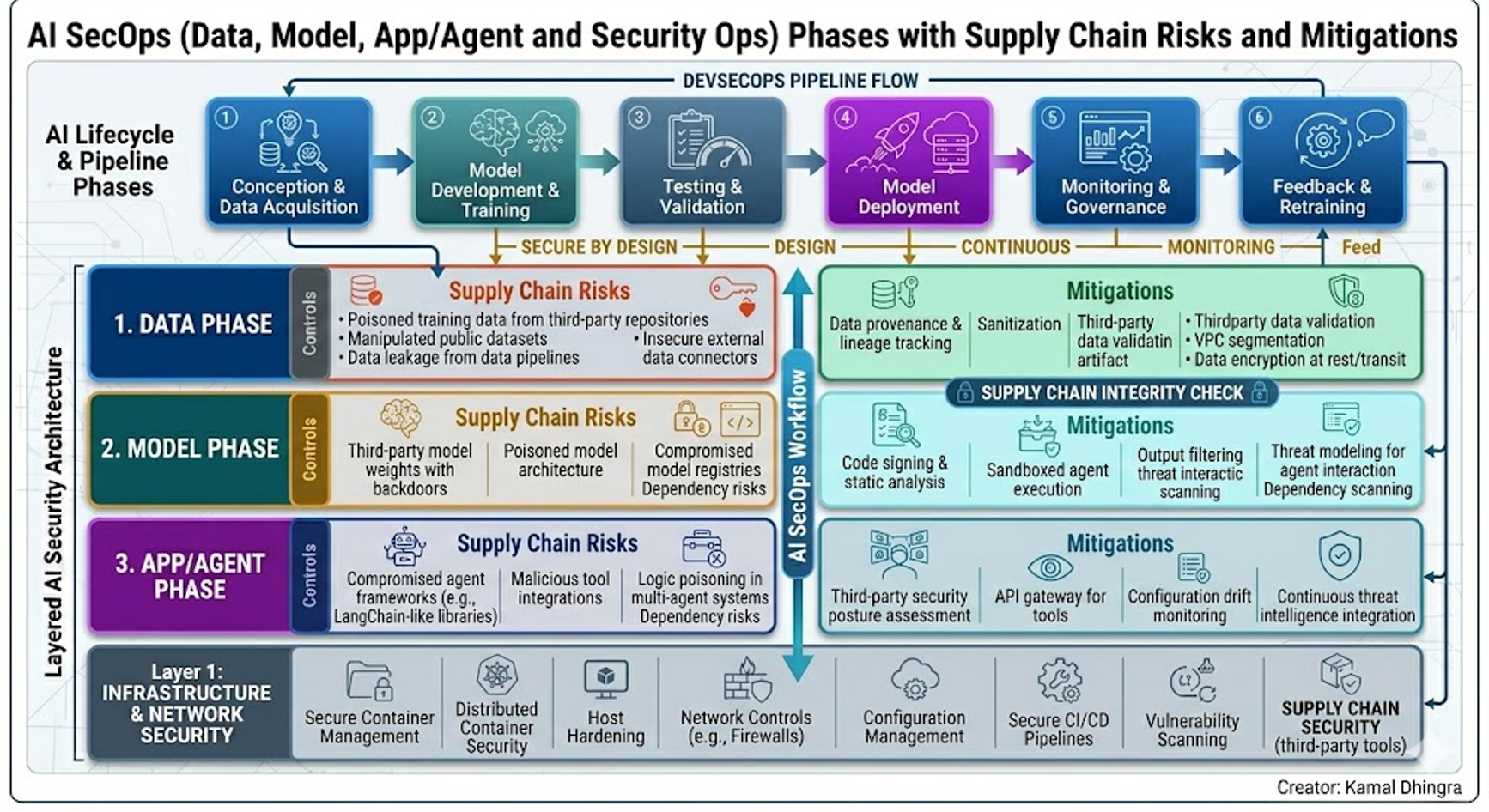
Figure 1: Vendor-Neutral Layered AI SecOps Architecture mapping Supply Chain Risks and Mitigations.
The Four Phases of AI SecOps
Layered Security Framework Breakdown
1. Data SecOps (Acquisition & Preprocessing)
Focus: Integrity, lineage, and privacy of data feeding upstream ingestion pipelines.
Supply Chain Risks
- Data Poisoning: Scraped or premium data manipulation designed to skew model logic or embed hidden triggers.
- Lineage Hijacking: Unvalidated training splits allowing untrusted or malicious source alterations.
- PII Leakage: Inadvertent ingestion of protected, toxic, or copyrighted information into the pipeline.
Strategic Mitigations
- Cryptographic Lineage: Use ledger-based hashing structures tracking data safely from ingestion to storage.
- Differential Privacy: Apply math-backed noise and masking transformations pre-training.
- Automated DLP Sanitization: Deploy in-line Data Loss Prevention filters blocking sensitive or corrupted artifacts.
2. Model SecOps (Development, Testing & Validation)
Focus: Defensive engineering around base weights, training code, and evaluation parameters.
Supply Chain Risks
- Malicious Base Models: Model weight files pulled from public hubs hosting latent remote-code execution (RCE) payloads.
- Backdoor Weight Injections: Embedded neural triggers that bypass standard benchmark validations but execute under specialized prompt conditions.
- Hyperparameter Exfiltration: Core intellectual property theft stemming from insecure fine-tuning configurations.
Strategic Mitigations
- Artifact Verification: Enforce strict cryptographic code-signing checks on model files prior to memory execution.
- Adversarial Red-Teaming: Embed automated evasion and poison simulation workflows into the CI/CD timeline.
- Model Watermarking: Imprint traceable semantic fingerprints into the model architecture to track origin boundaries.
3. Application & Agent SecOps (Deployment & Integration)
Focus: Run-time orchestration, multi-agent trust zones, and runtime interface tools.
Supply Chain Risks
- Prompt Injection: Malicious user prompt manipulation hijacking agent logic to trigger host operating systems commands.
- Cascade Failures: Amorphous cross-agent trust boundaries propagating compromise laterally down downstream dependencies.
- Unsanitized Output Injections: Directly parsing unchecked language model responses straight into system shells or code interpreters.
Strategic Mitigations
- Zero-Trust Prompt RBAC: Set up least-privilege permission criteria down to the granular agent/tool tier.
- Bidirectional Token Filtering: Execute real-time semantic monitoring of both inbound queries and outbound responses.
- Secure Sandboxing: Force all agent actions and automated tool interactions to process inside ephemeral, isolated containers.
4. Continuous Security Operations (Governance & Monitoring)
Focus: Continuous telemetry lake analysis, alignment guardrails, and compliance logs.
Supply Chain Risks
- Silent Model Drift: Gradual inference accuracy decay due to real-world data shifts, exposing hidden logic gaps over time.
- Model Extraction Attacks: Strategic attackers reverse-engineering structural model IP via repetitive, high-frequency API probing.
- Telemetry Gaps: Disconnected log tracking masking multi-turn, slow-pulsed profiling patterns across endpoints.
Strategic Mitigations
- XAI & Drift Ingestion: Establish continuous distribution tracking alongside localized activation map logging.
- Adaptive Rate-Limiting: Configure automated AI Gateway filters blocking iterative fingerprinting scrapers.
- Unified CI/CD Telemetry: Log immutable data records covering model updates, pipeline adjustments, and environment versions.
Wrapping up
Mitigating AI supply chain risk requires treating datasets as code, model weights as untrusted binaries, and generations as raw user input. By layering architectural boundaries like AI Gateways and MCP across the SecOps lifecycle, enterprises can deploy automated agentic networks securely without introducing structural single points of failure.
All content provided on this blog is for informational and educational purposes only. The views expressed here are mine alone and do not represent the views of my employer.